

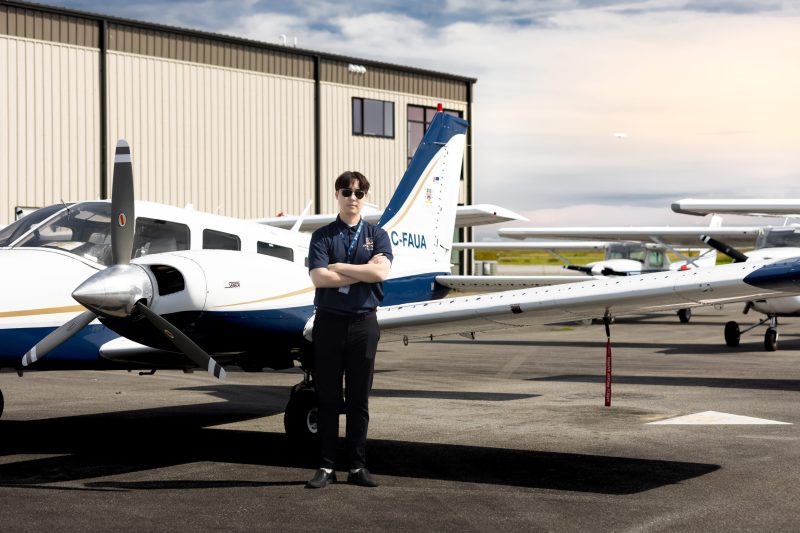
A grounded perspective on Flight School Canada 2026 and what aspiring pilots can expect before they sign up.
Why 2026 Is Different for Canadian Aviation
What’s on your radar when it comes to aviation? What’s your sense of 2026? The feeling is certainly different from how it felt running up to 2020.
There is steady recruitment and subsequent employment opportunities opening up with airlines. Additional regional carriers are being added, and operational capacity is increasing for charters and cargos. Finally, we are seeing a significant cohort of pilots begin to retire, which will further increase demand for employment in the aviation industry.
One of my students recently said, “It feels like this might actually be the right time to start.”
He is correct.
Flight schools in Canada are once again receiving inquiries from students expressing their desire to pursue a serious career in aviation.
What Flight School in Canada Looks Like in 2026
It is common for individuals to romanticize or overly dramatize the experience of flight school. In truth, it is a structured, logical, and very practical experience.
Typical Canadian flight schools include:
- Classroom learning
- Simulator training
- Training flights
- Licensing steps
Guidance by instructors
Insignia College, located in Delta, BC, aims to prepare students to face real-world aviation situations, not just to pass exams.
As one instructor said,
“We don’t train for perfect weather. We train for real life.”
That attitude is appreciated in Canada.
Grasping the Licensing Path in Canada
In 2026, the steps to become a professional pilot in Canada will still be the same:
- Private Pilot License (PPL)
- Commercial Pilot License (CPL)
- Other classifications (instrument, multi-engine, instructor, etc.)
The following is important for clarity:
- To join the Commercial Pilot License (CPL) Program, students need to possess a Private Pilot License (PPL).
- There’s no way around it.
- This is true for a number of students, so the explanation clears up the path.
Entry Standards Always Verify the Official Site
Instead of listing specific requirements here, it is best to check the official admission criteria on Insignia College’s website since it is always up to date.
Your training history may alter the requirements.
If you need clarity on your status, Insignia College’s admissions team can guide you based on your individual case.
Typical Document Requirements
Students heading toward professional flight training generally need to provide the following documents:
- A valid Private Pilot License (PPL) is required for CPL entry.
- A valid passport (to confirm your age and identity) needs to be presented during PPL admission.
- Medical documents proving the individual is fit to fly.
Previous records of flight training.
- If you do not have a PPL, you will need to obtain one before you can continue on to your CPL.
- It’s best to check with the admissions team and confirm if anything has changed before submitting anything.
What Will Be Strengths of Canadian Flight Schools in 2026
Canada has a distinct advantage in the training of pilots.
You do not only train in the perfect conditions.
You train in:
- Different weather conditions.
- Different types of coast [i.e. an a coast / a lake some type of coast?]
- Whether the airspace is controlled or uncontrolled.
- Actual navigation problems.
Training in Delta, and British Columbia in particular, provides a lot of scenarios for pilots and helps to build their confidence.
One student said:
“Here in Canada, you are forced to think while you are up in the air, and I’d say that’s a really great thing.“
He wasn’t wrong.
2026: Technology and Flight School Simulators
There has also been a change in the use of flight simulators in Canadian flight schools in 2026.
They are now more than simply reserve pilots for inclement weather days. They are becoming integrated into the training strategy. Students are now practicing:
- Emergency procedures
- Instrument flying
- Decision making under pressure
- Airspace navigation
- Workload management
To reduce stress and increase safety, students are required to imagine and mentally go through the situation before actually stepping into the aircraft.
Canada provides a well-regulated system in comparison to most other countries, making it a good option for flight training. Canada also provides a good option for flight training. Canada provides a good option for flight training. Canada provides a good option for flight training. Canada provides a good option for flight training.
Though Insignia College offers a general overview of visa procedures, it cannot provide any guidance on immigration or legal matters. Students are required to consult with a legal immigration professional or lawyer.
Advancing Regulations on Clearing Canada’s Skies
Before choosing a flight school in Canada in 2026, students should ask themselves:
- Is the program aligned with Transport Canada requirements?
- What is the progression from PPL to CPL?
- How are flight hours structured?
- What kind of aircraft and simulators are used?
- What student support services are available?
With these questions, you can make a confident decision.
Reasons Students Select Insignia College
Students primarily select Insignia College due to the following reasons:
- Organized, professional instruction
- Well-defined career instruction
- Knowledgeable instructors
- Positive classroom atmosphere
- Compliance with Transport Canada
- Instruction in Delta, BC’s active airspace
The right training environment is critical to success in the aviation industry.
Planning to Attend Flight School in Canada in 2026?
If 2026 is calling you to take a step forward, it’s a sign to listen.
Rushing is not a part of the flight training process.
What are the next steps? Have you cleared your mind? If you’re flight training in Canada, certainly. If you’re thinking of training in Canada, you’re thinking of training in Canada. Your first contact is with the admissions team.
The first contact is all it takes to turn ‘maybe someday’ into ‘let’s go.’