
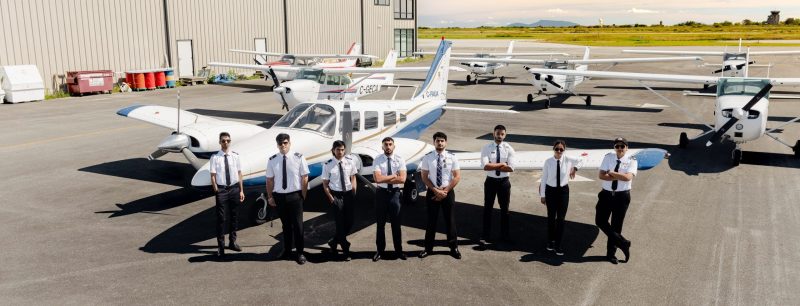
Obtaining a commercial pilot license in Canada requires flight training, ground school, flight experience, a medical certificate, and a flight test by Transport Canada.
The First Steps Toward a Commercial Pilot License
Becoming a commercial pilot in Canada is a long and challenging process.
Breaking it down into smaller stages can help accomplish the larger goal of becoming a commercial pilot.
On the first day of flight training, the overall goal is not to become an airline pilot. The ultimate goal should be to develop the habits and skills necessary to fly an aircraft and to be responsible for the safety of others.
In 2026, prospective students researching Commercial Pilot License Canada programs should understand this process.
A commercial pilot license is a major milestone, but is a part of a larger goal in the aviation industry.
In addition to training, Insignia College students can further their knowledge and practical skills with additional flight training.
What Is a Commercial Pilot License?
A Commercial Pilot License allows a pilot to exercise the privileges of commercial flying under Canada’s aviation regulations.
A Private Pilot License does not qualify a pilot to exercise commercial flying privileges.
A candidate must have the following skills and knowledge to be successful:
- Thorough knowledge of aviation
- Flying skills
- Practical judgment
- Aircraft management
- Knowledge and understanding of aviation regulations
- Ability to fly safely and professionally
Holding the licence is a confirmation that the candidate has the ability and knowledge to assume the responsibilities of commercial flying.
Step 1: Start With Your Private Pilot Licence
Students who are taking the CPL pathway at Insignia College first get their Private Pilot Licence (PPL).
During the training for this licence, the student pilots learn how to control an aircraft and how to land and take off.
Other skills include navigating and communicating by radio.
There are also the skills of planning flights and understanding the weather and aviation laws.
Step 2: Acquire Flight Experience
There are a lot more flying hours required for training for the Commercial Pilot Licence (CPL) than the Private Pilot Licence (PPL).
For the traditional CPL pathway for aeroplanes, Transport Canada states that a candidate must have at least 200 hours of flight time as an aeroplane pilot-in-command, which is again subject to regulatory requirements and credits.
Those flight hours are not to simply meet a requirement.
You gain flying experience with each flight.
Every flight offers an opportunity to practice management of an aircraft, decision making and navigation.
Experience Drives Decision Making
What if you had to make decisions about flights with very little experience with different types of weather?
As your experience grows so does your ability to make sound decisions based on more information.
You learn how various conditions affect the flight.
You learn when and how to adapt a flight plan.
It’s hard to replace that experience with classroom teaching.
Step 3: Complete Commercial Ground School
There is a large academic component of commercial pilot training.
Transport Canada requires a minimum of 80 hours of commercial ground school instruction to complete the Commercial Pilot Licence – Aeroplane.
Areas of study include but are not limited to:
- Air Law
- Meteorology
- Navigation
- Aerodynamics
- Human factors
- Flight operations
- Aircraft systems
It is difficult to grasp some concepts at first.
Through training and practice, students start seeing how different areas of theory actually apply to flying.
You learn how to derive routes based on your knowledge of regulations.
Flight planning uses navigation theory and knowledge of both meteorology and air law.
One of the most important aspects of practical training is actually applying what you’ve learned in the classroom.
Step 4: Complete the Required Commercial Flight Training
Training for the Commercial Pilot License builds on the skills and experience acquired during PPL training.
Training focuses more on precision and refinement.
Training and practice lead to the development of advanced skills in areas such as:
- Aircraft handling and manipulation
- Navigation
- Planning and preparing for flights
- Decision making
- Instrument training
- Emergency procedures
Some individuals take quickly to a given maneuver. Others require many additional lessons. Ultimately, the goal is to acquire the skill safely and consistently.
Step 5: Meet the Medical Requirement
Medical certification is another important aspect of the CPL process.
For a Commercial Pilot Licence – Aeroplane, Transport Canada requires a valid Category 1 Medical Certificate.
Students who want to make aviation their career should be aware of the medical requirements early in their training.
It is one less uncertainty to worry about later.
Step 6: Prepare for the Written Examination
Commercial pilots must provide proof of their knowledge through a Transport Canada examination.
Ground School is vital to prepare for this step.
Do not consider this a hurdle to clear with a passing mark.
Everything you learn in this course has a direct impact on the decisions you make as a pilot.
Step 7: Complete the Commercial Pilot Flight Test
The last steps of CPL training encompass the required flight test.
The focus is on bringing all the skills together and applying them in a safe and competent manner.
It is understandable to feel anxious about a flight test.
Your flight instructor should practice the required exercises with you beforehand and help you identify areas requiring more work.
How Long is the Training to Become a Commercial Pilot?
It doesn’t take the same length of time for everyone.
There are various aspects that influence training time, such as:
- The frequency of training
- The weather
- The availability of an aircraft
- Previous flight experience
- Individual progress
- Additional practice required
Someone who trains consistently may progress faster than someone who trains infrequently.
That’s why students should be cautious in choosing a flight school just based on the shortest completion period offered.
Flying is a skill.
Skills take time and practice to perfect.
What Documents Should I Prepare?
Students looking to enroll in the CPL program at Insignia College must first confirm the current admissions requirements.
A Private Pilot License (PPL) is a prerequisite to enrolling in the CPL program.
A passport is required for verification and identification purposes.
Depending on your situation, additional documents may be required.
The best approach is to contact admissions to find out what the current requirements are.
What About International Students?
International students have questions concerning the Visa process.
Insignia College is not authorized to give legal and/or immigration advices.
For questions regarding the eligibility of a study permit and/or immigration issues, students can consult the following:
- Immigration, Refugees and Citizenship Canada (IRCC)
- A licensed immigration consultant/lawyer
Immigration regulations and laws are subject to change and may vary by country and/or jurisdiction, therefore individual requests for clarification should be addressed to the appropriate authorities.
What Happens Next?
Once you’ve earned your CPL, you begin thinking about the next step in your pilot training.
Some possible options include:
- Flight Instructor Rating
- Multi-Engine Rating
- Multi-Engine Instrument Rating (Group 1)
- Night Rating
There are no set rules to what path a commercial pilot will take.
Some will choose to become a flight instructor and some will build time and experience for commercial operations.
With experience you will learn more about the career opportunities available to commercial pilots and the diverse path options.
In this book, we invite you to take the time to carefully consider your commercial pilot training options. Choosing the right training facility is of the utmost importance.
In our Delta, BC campus, students have access to experienced instructors, aircraft, simulators and a progressive training environment to build their aviation knowledge and skills.
The Insignia College admissions team is available to answer your questions. You don’t need to know your entire aviation career plan. You simply need to have a plan for your next step and for many aspiring professional pilots the CPL is the next step.